



Mark Amery – 27 September, 2011
For somewhere like Thermostat I use the term private gallery rather than dealer. For while the business of such a gallery remains selling work, their ambit tends to be broader, and more focused on developing a territory than an artist stable. They fill a gap found wanting in a community that has enough strong artists and an engaged public and buyers around it to make it a going concern.
If you were to draw up a map of current significant spaces for contemporary New Zealand art, I’d point to Thermostat Gallery in Palmerston North as one of the lower North Island’s lynchpins. The fact that this will be new to many readers - uncharted territory - is testament to how geographically limited our personal cartographies can be.
Blindspots exist when an increasingly globalised way of doing business encourages us to judge the art world around a hierarchy based on national and international visibility, rather than regional connectivity.
Our own digital reach meanwhile encourages us to think that we are connected to everything, but every network has areas that are out of range. The Auckland Art Fair, for example, may help the Aucklander appreciate that there are galleries like Paul Nache, Brett McDowell and McNamara based in cities in which they don’t coffee, but not all such galleries focus on being mobile like these. Whether galleries need to be mobile to survive long-term is another question - but then, not every operator sets up to be in business for life, or wants to roam around the traps with their stable.
For somewhere like Thermostat I use the term private gallery rather than dealer. For while the business of such a gallery remains selling work, their ambit tends to be broader, and more focused on developing a territory than an artist stable. They look to fill a gap found wanting for exhibition and community in a location that has enough strong artists, and an engaged public and buyers around it to make it a going concern.
A quick whizz through their recent exhibition programme marks Thermostat as a strong, developed example. Recently celebrating ten years, next year the gallery is planning to call it a day (director Catherine Russ says its simply time to move on to other things). This commentary then is in part about ensuring the gallery is recorded on this particular map.
Thermostat’s principal focus are artists based or originating in the Manawatu and Whanganui areas, which helps explain the appearance of everyone from Karl Maughan to Anton Parsons (both were raised in the Manawatu). The exhibition programme has been marked by a steady stream of group shows I never get to, but whose arrangement of artists pay testament to the gallery’s own strong reach and curatorial eye in terms of providing exhibition to interesting contemporary artists.
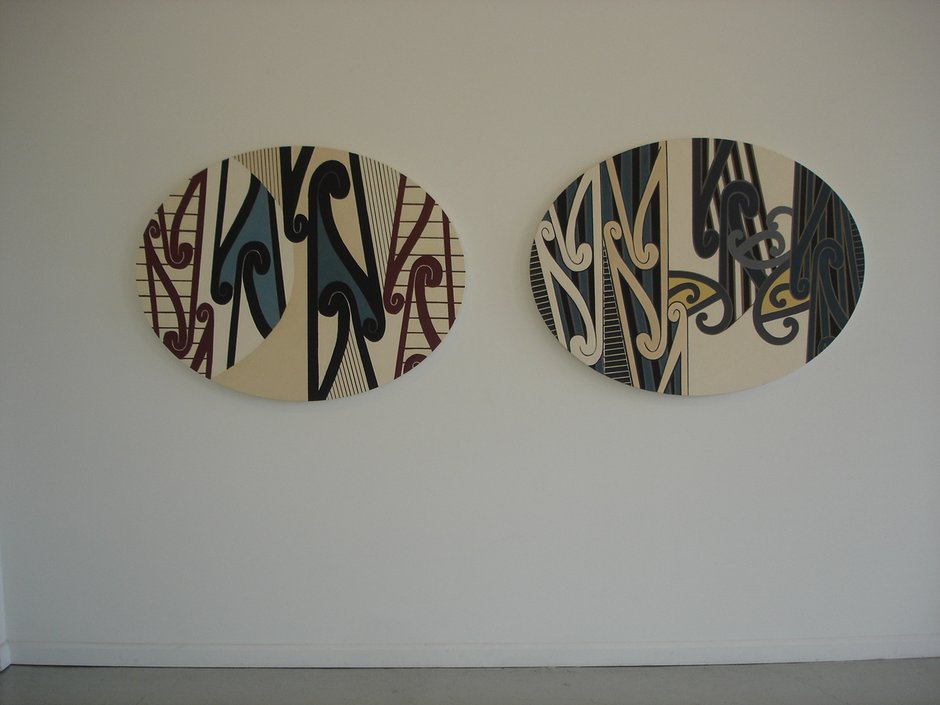
Last week I rectified my personal situation, returning to Thermostat after a long absence. Wahine is naturally a group show of Maori women artists (six), to be followed by the male equivalent, Tane. These exhibitions reflect the impact of Palmerston North’s most distinctive strength in the visual arts, Massey University’s Maori Visual Arts programme led by Robert Jahnke. With a steady stream of graduates having built strong professional practices in recent years nationally, the city has become a mother lode for strong visual arts practice beyond the old Elam/Ilam model.
Thermostat is a small upstairs gallery blessed with great natural light, and an outlook over the city centre’s giant public square. It’s a place for modest shows, as Wahine is, but their breadth recognises the limited exhibition opportunities for contemporary artists to exhibit together.
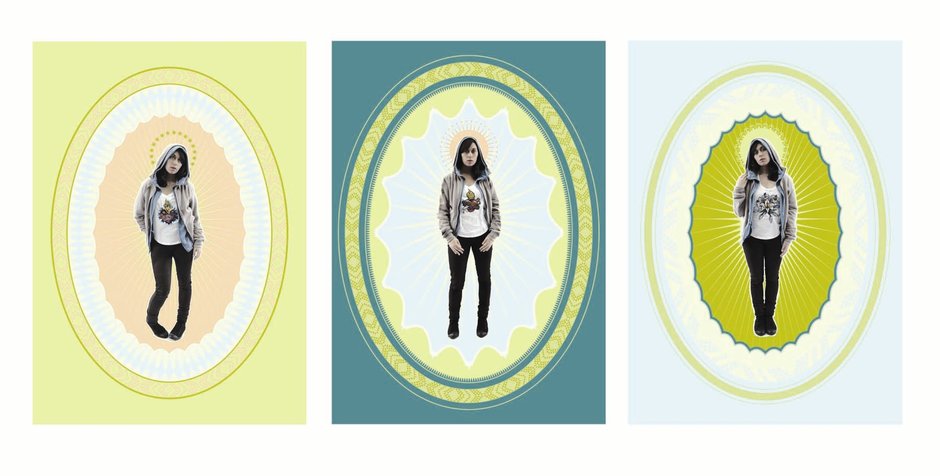
Unlike Maiden Aotearoa at City Gallery earlier this year (reviewed by Peter Ireland here) the focus of Wahine feels more about difference than an attempt to work around a theme. Yet it’s striking how many of the works are either also acts of activism or at the very least active in connecting aesthetic ideas to tangible real life issues. I was struck by how strongly this remains a grounding for Maori artists in relation to their peers.
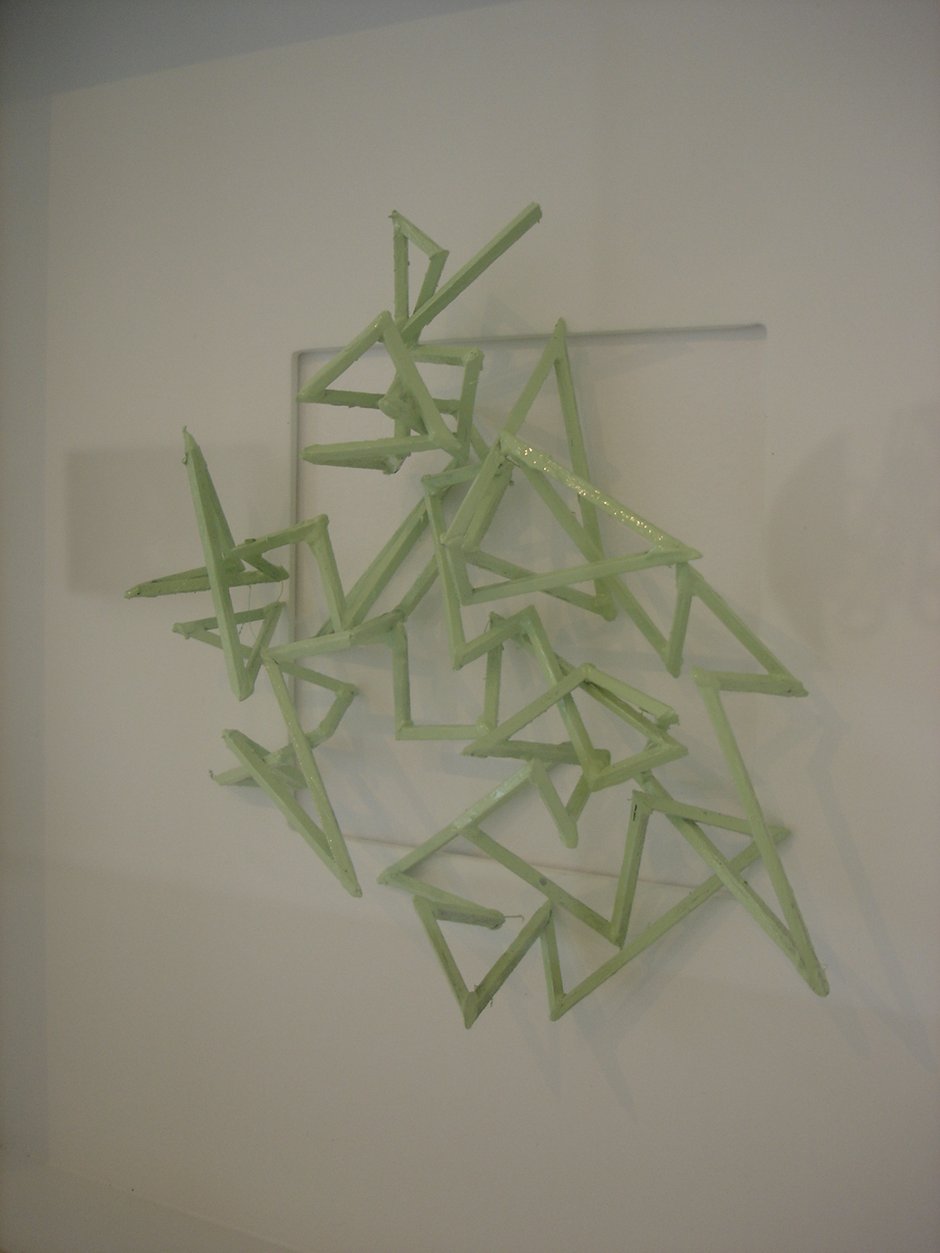
Saffron Te Ratana’s two small framed sculptural pieces, entitled baldly Apologise, could be studies towards her large collaborative sculpture with Hemi McGregor and Ngataiharuru Taepa at Te Manawa, which touches off the Urewera raids. Yet they’re beautifully charged here as small clusters, clenched fists, or barbed insignia. The complexity of perspectives and resentment that might be taken from the single word of their title, no matter what its context (personal disagreement or political demand) is represented in their tight sharp twists and turns. That they are badges, framed in white and put behind glass as museum objects rather than offered as decoration to be worn, adds to their impact.
Another small but charged gesture is Aimee Ratana’s Waka Huia in which the top half of a little photograph of a huia has dissolved into a set of vertical stripes, as if violently wiped clear, leaving the legs clinging fakely to a branch.
Comprised of seven interlocking canvases, Huhana Smith’s Te Rae works as a surreal puzzle of estranged components, held within a park landscape that resembles part failed real estate development and part cemetery or urupa. Visually connecting the work is a ribbon of slick road turning through the scene (perhaps it is also a river), which stresses our current drive-by mentality to both history and land. I also can’t help be reminded of the strange square out the window, with its odd collection of public objects, that mark out the city’s history and function.
Blocks on the side of the road in this painting resemble memorials, but are abstracted to carry multiple meanings and shifts in perceptions of scale. The workings on some mark them as books, and in other cases with attached headphones as digital reading and audio devices. They are then, whether books or graves, holders of history that provide building blocks for the future - just the sort of traces of a landscape’s history wiped clean in a property development.
The scene is also punctuated by the blackened trunks of mature trees, which hold bright green sprigs of new growth on their outer knobbly limbs. These are propped up by hoops, creating more interesting conversation between cultured and natural growth. The landscape itself has corners, as if were a room, and the sky is a giant series of arches, which could be as much a motorway underpass as it is a cathedral’s ceiling. The face of an ancestor appears in the short-cropped lawn, and the painting also includes the text ‘Te Rae’, which refers to the forehead frontal lobe and our brain’s function to recognise future consequences from current actions.
Te Rae is overly visually complex, with its multiple overlaid layers not synergizing as well as they might, yet it remains strong, fascinating work touching in fresh eloquent ways off vital environmental and human concerns that bring together Smith’s previous work as a curator at Te Papa and environmental restoration project at Kuku Beach, south of Levin. Its overlays of information and landscape are comparable for me to those in the work of Shane Cotton, but without the same painterly depth and play with light.
Rachael Rakena’s video Ka Uhia (Let it be known) has also been running as a large projection in Invercargill during the Rugby World Cup. Employing all the branding slickness of an All Blacks commercial, with the shimmering black light and activism of a vintage Ralph Hotere sculpture, the work features the Black Ferns - New Zealand’s women’s rugby team - running through various moves in ankle deep water.
Current world champions, the work’s concern as to why these athletes don’t have the profile of their male counterparts is clear. It acts as a commercial in the absence of any. As beautifully as the video is shot however I find their movements rather stagey (caught between sport and dance) and the effect tame and at a remove from the viewer, when it could be so much more tough and visceral. It lacks the mystery and sensuality for me of Rakena’s last work I’ve seen employing water in the blackness, He Waiata Whaiaipo.
Mark Amery
Recent Comments
Mark Amery
Thanks Jon, your criticism of my work is very valid, and I appreciate getting it. The review does spend an ...
jon jeet
I note that 'the EyeContact site is to have writers look at shows from the point of view of visitors', ...
John Hurrell
As the review's title is mine, may I chip in and endorse Mark's comments in relation to a much broader ...
 Two Rooms presents a program of residencies and projects
 Advertising in this column








This Discussion has 5 comments.
Comment
jon jeet, 6:24 p.m. 15 May, 2012 #
The conversation is centred more so on advertising the life span of a gallery space and how the gallery stacks up to other galleries situated in the North. Well not just gallery space, but the Visual arts programme and how the course is yielding results beyond “OLD Elam/Ilam models.
I’m not debating as to whether the gallery is in good stead or Massey is rising above the institutes of OLD, rather its relevance in discussing Maori Woman artists and their intent.
It’s not until a third of the way thru the discussion that we are introduced to the Topic heading “Maori women artists in Palmerston North.” Conversation should be primarily centred on how these artists collaborated on curating such an exhibit. With answers to why the term ‘Wahine?’ or their working relationship if any, living in close proximity?
Mark Amery, 10:44 p.m. 20 May, 2012 #
My conversation is principally with what I see. What I saw here gave no clues as to how the artists had collaborated nor what their working relationship is, hence these things aren't touched on. Rather it appeared as I describe it,a looser gathering of Maori women artists living locally, that followed one of men. The work didn't draw me to consider gender particularly and I note I didn't see the earlier Tane exhibition. I agree I spent an unusual amount of time on the context for the gallery and Massey but this came out of my perception that this history wasn't being recorded elsewhere. I am pleased to hear there is a story in the latest Art NZ.
John Hurrell, 8:17 a.m. 21 May, 2012 #
As the review's title is mine, may I chip in and endorse Mark's comments in relation to a much broader issue. The whole point of the EyeContact site is to have writers look at shows from the point of view of visitors who are not part of each gallery's inner circle, who attempt to use mainly the public information made available with each exhibition. We try and assess while maintaining a critical distance, so it is clear we are not a blatant PR service but independent commentators.
jon jeet, 10:57 p.m. 22 May, 2012 #
I note that 'the EyeContact site is to have writers look at shows from the point of view of visitors', and acknowledge that this isn’t a PR service. I was merely suggesting that there was less description, analysis and evaluation of the work at hand and more about the packaging. When I get my steak out of the fridge, I don’t acknowledge the brown paper packaging or the yellow bag with PAK n SAV inscribed onto it. I look at the thickness of the cut, the texture the colour, I then anticipate devouring it and think of the many ways I can cook it.
As for PR, Mark blatantly promotes Massey, the impact Robert Jahnke has had, as programme director for the visual arts and how that has yielded results in Palmerston North. What is Mark referring to when he speaks about ‘beyond the old Elam/Ilam model?’ Is Mark suggesting such models are being demoted? (OLD SCHOOL) I in turn have viewed this discussion as being a great advertising campaign for the Thermostat Gallery; it’s great that a gallery can accommodate a group of artists, as there are limited exhibition opportunities to exhibit in a space. Are these artists indebted to the gallery for showing their works?
Mark did have a similar opinion as me, posting “I agree, I spent an unusual amount of time on the context for the gallery and Massey.” If he would be so kind I would like him to elaborate on what he meant by “but this came out of my perception that this history wasn't being recorded elsewhere,” and how does that relate to the amount of time spent.
Mark Amery, 2:49 p.m. 25 May, 2012 #
Thanks Jon, your criticism of my work is very valid, and I appreciate getting it. The review does spend an unusual amount of time giving this 'packaging context' (perhaps at the expense of the exhibition - though I doubt I would have spent longer on it as a consequence) but this context did feel important. To elaborate - my perception is that for many readers outside the lower North Island there is limited knowledge of Thermostat gallery and of the Massey Palm North programme. I have no connections to either and am happy to be as critical of them as any other institutions, when occasion demands. I do believe however that an important part of criticism is giving out the bouquets as well as brickbats when earnt. Call that advertising/PR if you will.
In answer again to your query: The Old Elam/Ilam model refers to the feeling that once you went to one or the other if you were serious/severely talented. That's fractured now and there are now artists coming out of AUT, Massey's campuses and other schools that have grown hugely in the last decade that are changing this map. Curators and critics need to take heed.
Participate
Register to Participate.
Sign in
Sign in to an existing account.