
John Hurrell – 24 July, 2010
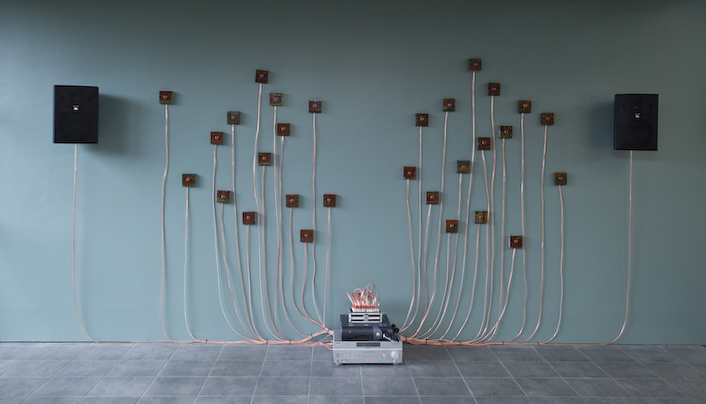
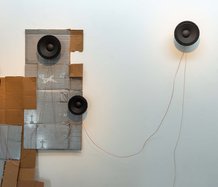
Within this intriguing idea, the recordings are unmistakenly strange. Hammes' artists often sound like zombies - their voices disembodied, monotonous and lacking inflection, as if very tired or drugged. With the kauri squares positioned symmetrically on a blue-green wall, and a speaker at each side, we not only have the artist using hypnotism to ‘draw out' language from his ‘collaborators', but the buttons and speakers set up verbal expressions - in the form of spoken words - as drawings in space.
Auckland
Jacob C. Hammes
Synesthetic Collection No.1
Te Tuhi Drawing wall
10 July - 29 August 2010
Jacob C. Hammes is an artist and musician from Chicago who is unusual in his approach to art making. He incorporates his skills as a hypnotist as part of his art methodology, regarding it as a serious tool and not something to be used for trivial entertainment. It is a means for him to help people discover creative ideas and thoughts within themselves they would normally not have access to. (Matt Mullican is another artist who uses hypnosis, but he uses it to have himself put into a trance, after which he draws in front of an audience.)
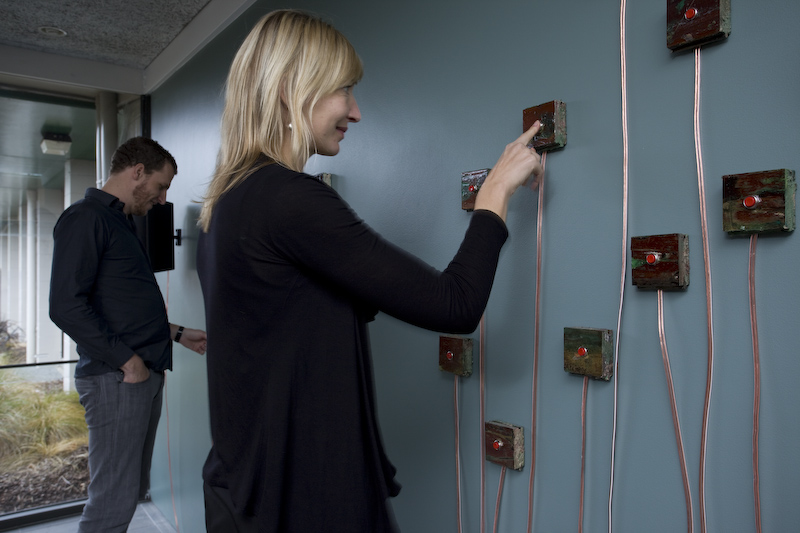
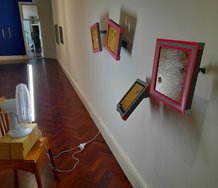
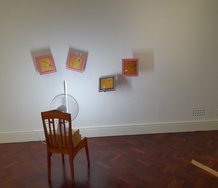
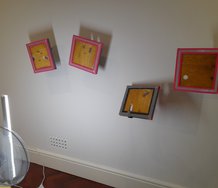
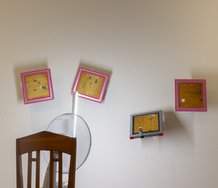
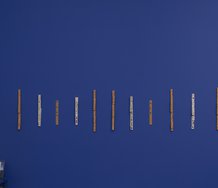
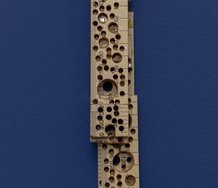
In this Te Tuhi exhibition Hammes uses hypnosis to explore synesthesia, that strange condition when senses get muddled so that for example, a person might hear sounds by looking at certain colours, or vice versa. He has made a series of sound recordings using the voices of artist friends whom he has hypnotised and then presented with sounds or colours (using his laptop) in order that they tell him what kind of ‘cross-over’ responses resulted. He has collected over 130 samples and distributed them amongst 28 buttons set into squares of old, darkly varnished, kauri planks, painted to look mouldy and worn. Using a computer each button has its pool of samples reshuffled and randomly selected so that repetition is avoided. That unpredictability prevents the work from being like a recited poem you can replay at will.
Within this intriguing idea, the recordings are unmistakenly strange. Hammes’ artists often sound like zombies - their voices disembodied, monotonous and lacking inflection, as if very tired or drugged. With the kauri squares positioned symmetrically on a blue-green wall, and a speaker at each side, we not only have the artist using hypnotism to ‘draw out’ language from his ‘collaborators’, but the buttons and speakers set up verbal expressions - in the form of spoken words - as drawings in space: linear aural traces. Such verbal descriptions are never overlapped, only spoken one at a time, though internal phrases are often obsessively repeated, like gramophone needles stuck on old records.
Here is a selection of some of the unusual phrases elicited from subjects being shown various stimuli, during what Hammes calls his ‘Deep Imagination Therapy’. In print they are completely severed from the voices speaking them. For example: ‘walking on wet sand…makes suction under your feet’, ‘slimy’, ‘like a really clean mist’, ‘nickel on a leaf’, ‘like a bubble before it’s popped’, ‘like cartoon sirens of a police car’, ‘the lime green sounds like evening crickets to me and the (other) green on the painting sounds like disco music’.
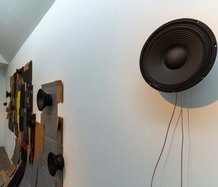
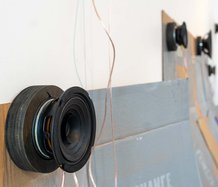
When cut off from their context these become like isolated lines in a poem, floating independently of each other, perhaps to be savoured like a haiku, or as a simple image that is mentally vivid. However the pieces of kauri tongue and groove enclosing the red buttons, and the green wall itself with speakers, cables and computer, provide a visual image that is very dominant.
Too much so in my view. It distracts from the aural content. I would have preferred mental images only, with the computer equipment and speakers all hidden by a white wall - leaving only 28 buttons, no kauri. That way you would really focus intensely on the information transmitted by the voices. I think the work as it is, is overloaded. Simpler would have been better.
John Hurrell
 Two Rooms presents a program of residencies and projects
 Advertising in this column





This Discussion has 0 comments.
Comment
Participate
Register to Participate.
Sign in
Sign in to an existing account.